Accredited Industrial Manometer Calibration in Wisconsin
Manometer Calibration in Wisconsin is performed by ISO/IEC 17025-accredited laboratories to recognized acceptance criteria, with documented uncertainty and NIST-traceable results.
Quote Manometer Calibration — Wisconsin
Response within one business day
Service Overview
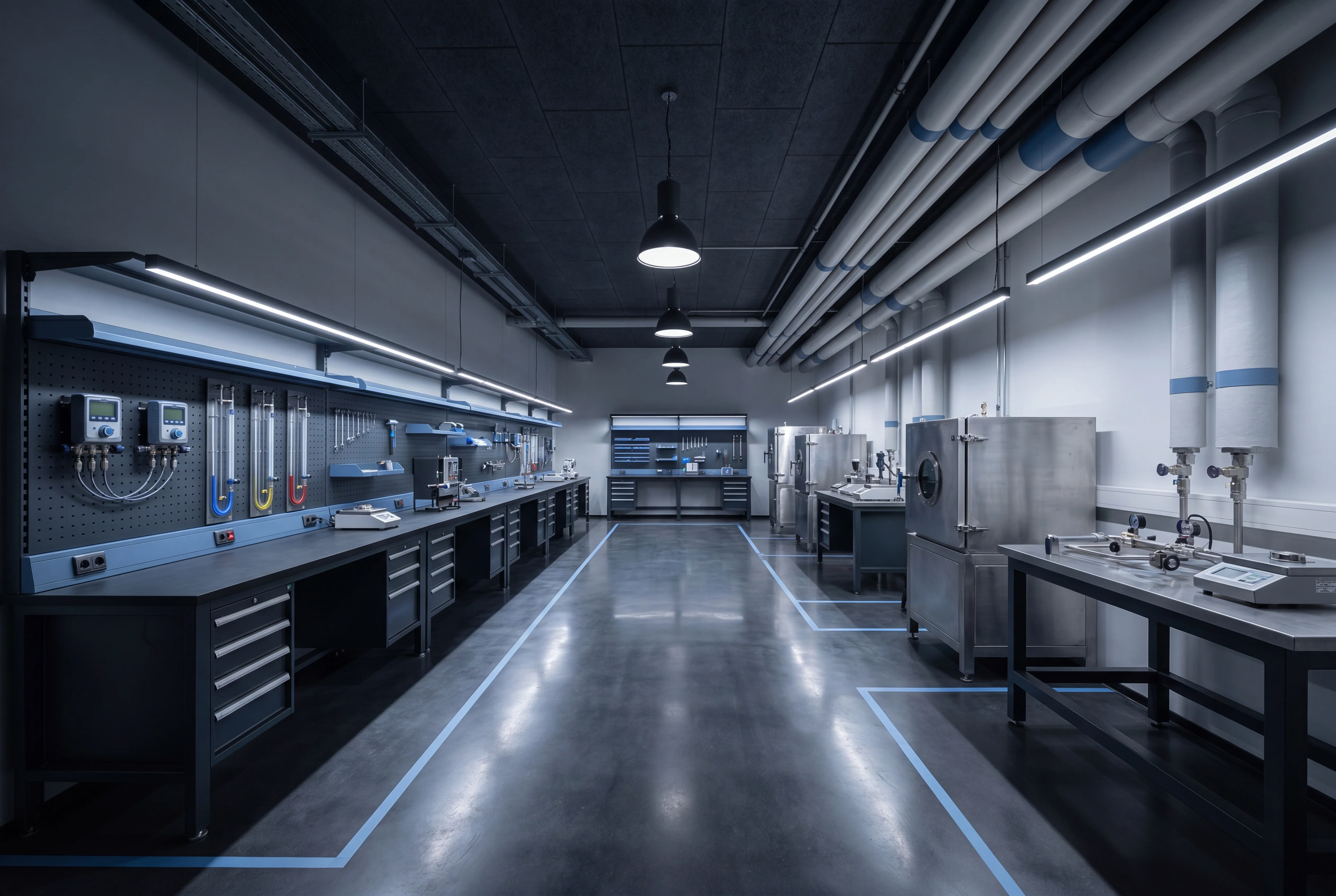
U-tube Manometer Calibration
Calibration of U-tube manometers requires rigorous evaluation of both the primary measurement scale and the fluid dynamics that dictate the indicated pressure. Because these instruments rely on the physical displacement of a liquid column - typically utilizing water, mercury, or proprietary gauge fluids - the calibration process must meticulously account for environmental variables that directly alter fluid density and hydrostatic equilibrium. Calibration is performed under ISO/IEC 17025 accreditation protocols to ensure documented measurement traceability to national metrology standards, such as those maintained by NIST. The verification procedure involves applying highly stable reference pressures using precision automated controllers or deadweight testers, subsequently comparing the standard against the manometer's observed differential height.
Critical parameters evaluated during this calibration sequence include:
- Verification of scale linearity, absolute zero-point alignment, and graduation accuracy across the entire operational range.
- Application of critical temperature corrections, as thermal expansion continuously alters the specific gravity of the indicating fluid.
- Mathematical compensation for local gravity variations, which fundamentally impact the primary hydrostatic pressure calculation.
- Inspection of the bore tubing for internal contamination or surface tension anomalies that could distort the meniscus and induce parallax reading errors.
- Pneumatic leak testing of the manifold and connection fittings to confirm absolute system integrity under sustained static pressure.
Digital Manometer Calibration
Digital manometer calibration is performed under strict ISO/IEC 17025 accredited procedures to ensure the integrity of electronic pressure measurements. Unlike liquid-column counterparts, digital manometers rely on piezoresistive or silicon capacitive sensors, which require precise voltage-to-pressure correlation. High-accuracy pneumatic or hydraulic comparators are utilized alongside NIST-traceable reference standards to evaluate the device across its full operating range. The calibration process involves multi-point verification to analyze key performance characteristics:
- Hysteresis and Linearity: Assessment of sensor response during both increasing and decreasing pressure cycles to identify deviations in the transducer element.
- Repeatability: Evaluation of the instrument's ability to provide consistent readings under identical pressure conditions.
- Zero and Span Adjustment: Corrections applied to align the digital output with reference standards at both zero pressure and full-scale limits.
- Temperature Effects: Verification of thermal compensation stability, as digital sensors are susceptible to drift caused by ambient temperature fluctuations.
All measurements are conducted in accordance with ASME B40.7 standards, providing documented test uncertainty ratios (TUR) to support industrial compliance and quality management systems.
Manometer Calibration in Wisconsin
Wisconsin's industrial infrastructure, extending from the heavy manufacturing corridors of the Milwaukee metropolitan area to the specialized processing facilities in the Fox River Valley, necessitates rigorous verification of low-pressure measurement instruments. Within the Menomonee Valley and the expansive New Berlin Industrial Park, digital, inclined, and traditional U-tube manometers are deployed extensively to monitor complex HVAC system performance, evaluate draft pressures in industrial furnaces, and verify differential pressures across heavy-duty filtration arrays. The region's sustained concentration in industrial machinery manufacturing and commercial printing requires strict adherence to operating parameters, where minor deviations in low-range pressure measurements can directly compromise product integrity and environmental controls. In the extensive pulp and paper manufacturing sectors situated along the Fox River, facilities rely on continuous, precise differential pressure monitoring to manage controlled drying environments, pneumatic conveying systems, and boiler draft mechanics, driving continuous local demand for verifiable manometer accuracy.
More on manometer calibration in Wisconsin
Beyond traditional manufacturing hubs, the biotechnology and life sciences corridors centered in Dane County establish even more stringent requirements for manometer performance. Research and development facilities, alongside active pharmaceutical ingredient manufacturers operating in and around Madison, depend on highly accurate manometers to map and verify cleanroom pressure cascades. Maintaining exact positive or negative pressure differentials is a structural requirement for contamination control and airborne pathogen containment in these facilities. Consequently, the operational pressures on these local sectors dictate that instruments undergo systematic verification to ensure that readings remain accurate within strict zero-tolerances. Furthermore, the extreme seasonal temperature fluctuations characteristic of Wisconsin summers and winters can induce thermal drift in facility-embedded digital pressure transmitters and fluid-based manometers, making environmentally stabilized calibration routines an essential aspect of local facility management.
Technical Framework and Metrological Compliance
The metrological verification of manometers in these demanding environments is governed by strict adherence to national and international standards. To satisfy the quality assurance mandates of ISO 9001 and the technical competence requirements of ISO/IEC 17025, manometer calibration procedures must demonstrate an unbroken, documented chain of traceability directly to the National Institute of Standards and Technology (NIST). The core calibration process involves the precise application of known reference pressures across the instrument's operational span. For ultra-low differential manometers frequently used in Wisconsin's cleanroom and HVAC applications, these reference pressures are typically generated utilizing high-resolution pneumatic pressure controllers or validated primary standard liquid manometers. The calibration protocols systematically evaluate parameters such as hysteresis, linearity, repeatability, and zero-point stability, isolating the most common sources of measurement uncertainty inherent to both solid-state piezoresistive sensors and traditional fluid-column designs.
For the medical device and pharmaceutical sectors localized in the state, regulatory compliance introduces additional layers of complexity to the calibration process. Facilities subject to FDA 21 CFR Part 211 regulations must maintain documented evidence of equipment suitability and calibration status. This dictates how manometer calibration data is gathered, recorded, and applied to facility maintenance schedules. When these instruments are utilized to monitor environments compliant with ISO 14644 cleanroom standards, they must possess verified accuracy to prove that inter-zone pressure differentials meet exact operational limits. This typically requires instruments to maintain tolerance grades of +/- 0.5 percent of full scale or better, depending on the specific room classification. Furthermore, as local industries increasingly adopt digital manometers integrated with automated building management systems, these devices are subjected to stringent data integrity validations. Comprehensive metrological verification ensures these critical measurement devices operate well within defined error margins across their entire operational range, satisfying internal quality control mandates and withstanding the rigorous scrutiny of external regulatory inspections.
Related Services
Pressure Gauge Calibration
View in Wisconsin ↗ RelatedDigital Pressure Gauge Calibration
View in Wisconsin ↗ RelatedPressure Transmitter, Transducer & Sensor Calibration
View in Wisconsin ↗ RelatedPressure Switch & Relief Valve Calibration
View in Wisconsin ↗ RelatedLeak Tester Calibration
View in Wisconsin ↗ RelatedPiston Gauge Calibration
View in Wisconsin ↗Request manometer calibration in Wisconsin.
Submit instrument details to receive an itemized quote within one business day. NIST-traceable results, documented for audit and compliance.