Accredited Industrial Differential Pressure & Magnehelic Gauge Calibration in Missouri
Differential Pressure & Magnehelic Gauge Calibration in Missouri is performed by ISO/IEC 17025-accredited laboratories to recognized acceptance criteria, with documented uncertainty and NIST-traceable results.
Quote Differential Pressure & Magnehelic Gauge Calibration — Missouri
Response within one business day
Service Overview
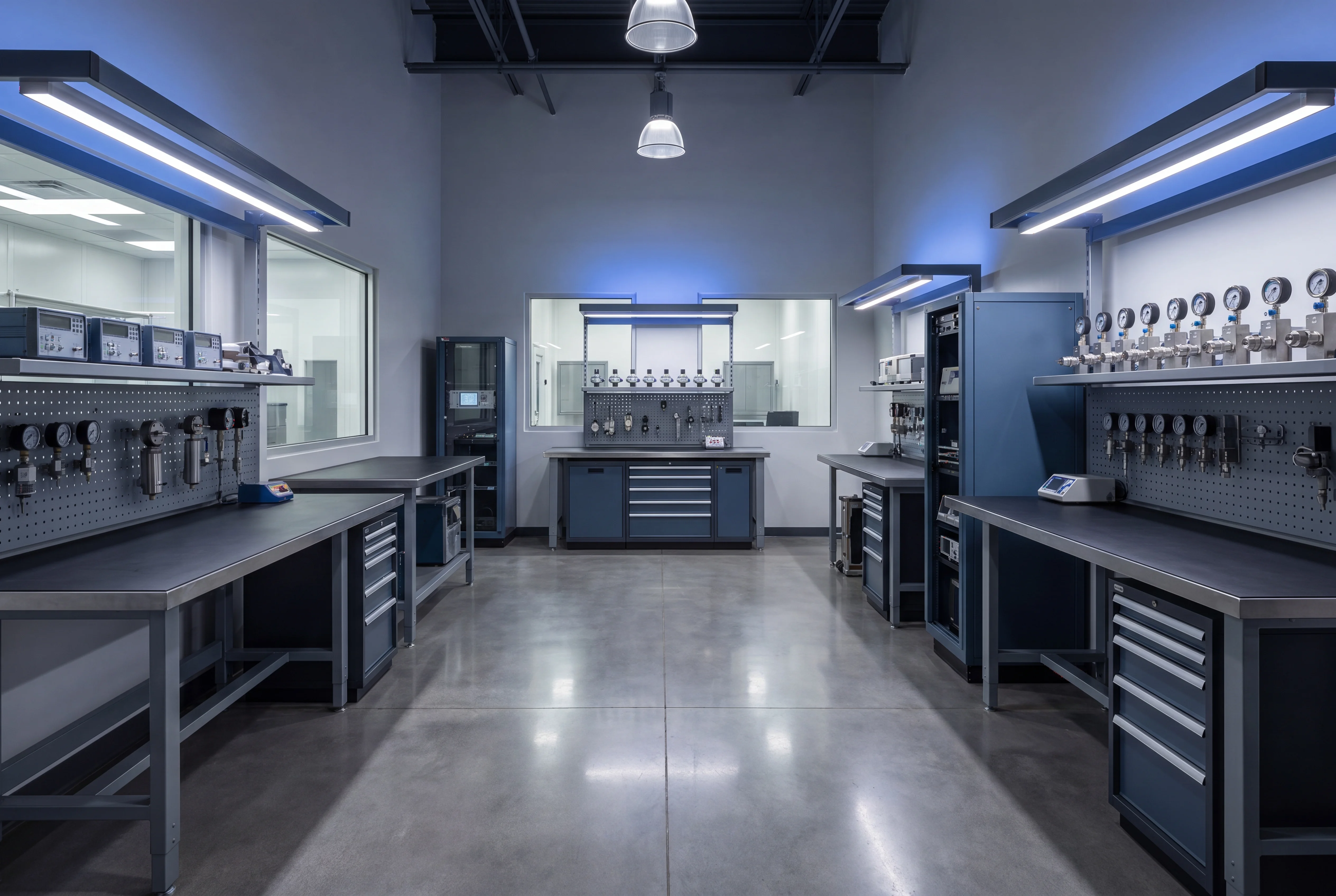
Diaphragm Differential Pressure Gauge Calibration
Diaphragm differential pressure gauges are critical instruments utilized for monitoring low-differential pressure applications, such as cleanroom environments, HVAC systems, and filter status. Because these instruments rely on the deflection of a flexible diaphragm to measure the difference between high and low pressure ports, rigorous calibration is required to detect mechanical wear, hysteresis, and sensor drift. Calibration of diaphragm-actuated instruments is performed using pneumatic deadweight testers or high-precision automated pressure controllers. Throughout the verification process, stable test pressures are applied to generate multi-point assessments across the specified operating range, typically measured in inches of water column (inH2O) or millibar (mbar).
To ensure documented reliability, differential pressure gauge calibration is conducted in accordance with ASME B40.100 guidelines and performed under ISO/IEC 17025 accreditation protocols. Standard verification procedures involve several key metrological assessments:
- Verification of zero-point accuracy and mechanical spanning adjustments.
- Multi-point linearity checks ascending and descending through the pressure scale to evaluate hysteresis.
- Leak testing of the high and low pressure cavities to verify diaphragm integrity.
- Generation of calibration certificates with full metrological traceability to NIST or equivalent national metrology institutes.
Magnehelic Differential Pressure Gauge Calibration
Calibration of Magnehelic differential pressure gauges is executed to ensure accurate measurement of low-pressure air and non-combustible gases across critical HVAC, cleanroom, and industrial environments. Because these instruments rely on sensitive diaphragm and magnetic linkage mechanisms to measure minor pressure differentials - typically ranging from fractions of an inch of water column (inH2O) to several pounds per square inch (psi) - meticulous procedural controls are necessary. The calibration process is performed using high-resolution digital reference manometers or micromanometers to generate precise low-pressure test points. Verification is conducted against documented manufacturer specifications or ASME B40.100 guidelines, typically requiring multi-point checks across the measurement span to evaluate linearity, hysteresis, and indication repeatability.
Measurement data is recorded to verify that instrument performance aligns with stringent operational tolerances. When necessary, internal zero and span adjustments are performed to bring the mechanical indicator back into acceptable operational status. Procedures are executed under controlled environmental conditions to mitigate temperature and ambient pressure variations that can induce significant errors in low-differential readings.
- Verification of diaphragm integrity and frictionless magnetic linkage movement.
- Multi-point pressure generation covering the full analog indicating scale.
- Metrological traceability established through NIST or equivalent National Metrology Institutes.
- Calibration protocols performed in strict accordance with ISO/IEC 17025 accreditation requirements.
Photohelic Differential Pressure Gauge Calibration
Photohelic differential pressure gauges integrate precise visual pressure indication with built-in relay switches for system control, requiring a dual-phase verification approach. Because these instruments serve both as monitors and active control elements in critical air or gas flow systems, calibration is performed to assess mechanical indication accuracy alongside electrical switch functionality. High-accuracy automated pressure controllers or standard reference manometers are utilized to generate stable, low-pressure differentials. These reference pressures are applied across the high and low ports to evaluate the instrument across its full operational range. Validation is performed under strict environmental controls and aligns with ISO/IEC 17025 accreditation parameters, ensuring all measurements maintain documented traceability to NIST.
The calibration protocol for photohelic instruments routinely encompasses the following technical evaluations:
- Verification of visual dial indication across multiple distributed points on the specific pressure scale.
- Actuation testing of high and low limit switches to determine exact set-point accuracy and repeatability.
- Measurement of the mechanical deadband, or hysteresis, during both rising and falling pressure cycles to verify relay stability.
- Zero-point verification, structural leak testing across the internal diaphragm assembly, and necessary mechanical span adjustments.
Technical Detail
Digihelic Differential Pressure Gauge Calibration
Calibration of digital differential pressure controllers, commonly known as digihelic gauges, encompasses both pneumatic pressure verification and electrical signal measurement. Because these instruments function simultaneously as a local indicating display, a 4-20 mA transmitter, and a dual-relay pressure switch, a comprehensive calibration protocol is required to ensure multi-variable accuracy. Low-differential pressure references are utilized to apply stable, controlled test media across the high and low pressure ports, targeting specific measurement ranges that are often scaled in inches of water column (in w.c.) or Pascals.
The calibration procedure for digihelic-style instruments typically includes:
- Verification of the digital display across a multi-point scale to assess linearity, repeatability, and hysteresis against a high-accuracy standard.
- Measurement of the analog 4-20 mA output signal using precision digital multimeters to confirm transmitter output accuracy.
- Testing of the solid-state control switches to ensure activation and deactivation occur strictly within the programmed setpoint tolerances.
- Application of necessary zero and span adjustments to correct output drift resulting from piezoresistive sensor fatigue or minor overpressure events.
All differential pressure measurements and concurrent electrical verifications are performed under strict ISO/IEC 17025 accreditation parameters, ensuring unbroken metrological traceability to the National Institute of Standards and Technology (NIST). Fully documented test data, complete with calculated measurement uncertainties, verifies that the controller meets the stringent tolerance limits required for critical cleanroom environments, HEPA filter monitoring, and complex industrial ventilation systems.
Differential Pressure & Magnehelic Gauge Calibration in Missouri
In the industrial corridors spanning from the Kansas City metro area to the St. Louis bio-belt, differential pressure instrumentation represents a critical point of operational control. Facilities operating in the Cortex Innovation Community in St. Louis, as well as pharmaceutical manufacturing plants in Chesterfield, rely heavily on Magnehelic gauges to maintain strict pressure cascades in sterile environments. These pressure differentials prevent cross-contamination between cleanrooms and standard preparation areas, demanding precise calibration to ensure compliance with strict environmental envelopes. Similarly, the aerospace manufacturing cluster centered around Boeing's St. Louis facilities utilizes differential pressure transmitters to monitor composite curing ovens and clean room assembly areas where airborne particulate control is paramount. The precision of these instruments directly impacts the safety and yield of high-value biopharmaceutical batches and structural aerospace components, making regular calibration intervals an operational necessity rather than a secondary maintenance task. In these cleanroom environments, even a fractional deviation in water column inches can compromise pressure barriers, leading to costly batches being rejected or production lines being shut down.
More on differential pressure & magnehelic gauge calibration in Missouri
Beyond bio-pharmaceutical and aerospace applications, Missouri's heavy industrial manufacturing base drives significant demand for localized pressure calibration. The automotive assembly lines, including the Ford plant in Claycomo and the General Motors facility in Wentzville, utilize differential pressure systems within their paint booths and environmental control systems to manage airflow velocities and filtration efficiency. In the central and southern parts of the state, including the industrial hubs of Springfield and Joplin, food processing facilities and chemical formulation plants employ these gauges to monitor baghouse performance and dust collection systems. Regular calibration across these varied installations prevents dust accumulation, manages hazardous emissions, and ensures compliance with occupational safety parameters. Proper monitoring of these exhaust systems protects both facility personnel and the surrounding local environments from uncontrolled particulate release. Furthermore, agricultural processing plants, such as grain elevator networks along the Missouri River, rely on these differential indicators to prevent explosive dust concentrations in closed storage systems, linking sensor accuracy directly to facility safety protocols.
Technical Standards and Metrological Traceability
Calibration of differential pressure indicators and low-range Magnehelic gauges in Missouri facilities is governed by established metrological frameworks and rigorous technical specifications. Traceability to the National Institute of Standards and Technology (NIST) is maintained through a continuous chain of comparison utilizing high-accuracy pneumatic calibrators or micro-manometers with low-uncertainty profiles. Because Magnehelic gauges operate on a magnetic link principle rather than a mechanical liquid column or bellows, they are particularly susceptible to orientation-induced zero shifts and environmental temperature variations. Verification procedures must account for these design characteristics, requiring calibration in the specific mounting orientation (vertical, horizontal, or angled) encountered in the field to eliminate gravitational errors on the internal pointer mechanism. Technicians performing these procedures record deviations at multiple intervals across both ascending and descending pressure scales. This bidirectional testing is necessary to isolate hysteresis, which is the difference in gauge response when pressure is increasing versus when it is decreasing, a common phenomenon in diaphragm-operated indicators.
Regulatory compliance within Missouri's life science and manufacturing sectors necessitates adherence to specific quality standards, including ISO/IEC 17025 for testing and calibration laboratories. For pharmaceutical operations, calibration practices must satisfy the requirements of FDA 21 CFR Part 211.46, which mandates appropriate air filtration and pressure differentials in clean areas. Instrument tolerance grades are typically defined by ASME B40.100, where differential pressure gauges are calibrated against specified accuracy classes, often requiring a tolerance of +/- 2% or +/- 1% of full scale depending on the criticality of the process. Calibration protocols systematically document as-found and as-left data across multiple test points across the gauge's scale, verifying linearity, hysteresis, and repeatability to support comprehensive quality management systems. This documentation serves as essential evidence during corporate audits, OSHA inspections, and FDA evaluations, confirming that all safety-critical differential pressure gauges operate within their designated engineering limits. By establishing a rigorous calibration schedule that aligns with these standards, Missouri facilities can mitigate risk, maintain manufacturing consistency, and ensure compliance with both federal mandates and voluntary quality systems.
Related Services
Pressure Gauge Calibration
View in Missouri ↗ RelatedDigital Pressure Gauge Calibration
View in Missouri ↗ RelatedManometer Calibration
View in Missouri ↗ RelatedPressure Transmitter, Transducer & Sensor Calibration
View in Missouri ↗ RelatedPressure Switch & Relief Valve Calibration
View in Missouri ↗ RelatedLeak Tester Calibration
View in Missouri ↗Request differential pressure & magnehelic gauge calibration in Missouri.
Submit instrument details to receive an itemized quote within one business day. NIST-traceable results, documented for audit and compliance.