Accredited Industrial Pressure Transmitter, Transducer & Sensor Calibration in Hopkinsville, KY
Pressure Transmitter, Transducer & Sensor Calibration in Hopkinsville, KY is performed by ISO/IEC 17025-accredited laboratories to recognized acceptance criteria, with documented uncertainty and NIST-traceable results.
Quote Pressure Transmitter, Transducer & Sensor Calibration — Hopkinsville
Response within one business day
Service Overview
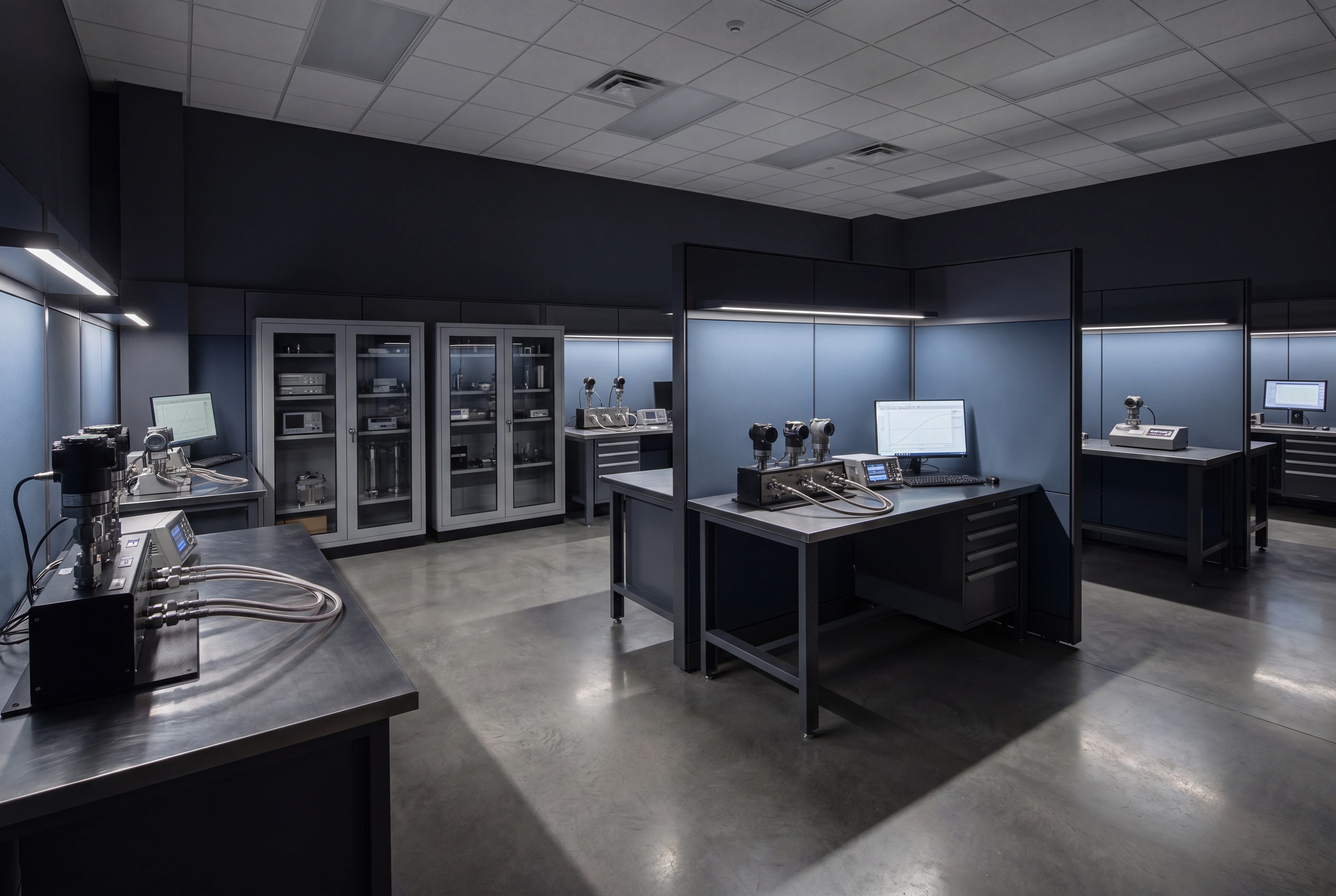
Differential Pressure Transmitter Calibration
Differential pressure transmitter calibration is performed to verify accuracy across complex flow, level, and filter monitoring applications. Due to the dual-chamber design of these instruments, calibration protocols require precise application of differential pressures while accounting for static line pressure effects. Metrological validation is executed using high-precision pneumatic or hydraulic pressure controllers and deadweight testers, ensuring direct NIST traceability. Evaluation encompasses critical performance parameters to isolate and correct systemic errors across the instrument's calibrated span.
The calibration process is governed by stringent technical criteria, aligning with ISO/IEC 17025 performance requirements. Testing protocols typically evaluate the following parameters:
- Static Pressure Shift: Verification of zero and span stability under actual operating line pressures to correct for physical housing distortion.
- Five-Point Hysteresis Testing: Sequential calibration at 0%, 25%, 50%, 75%, and 100% of span in both ascending and descending directions to detect mechanical lag.
- Turndown Ratio Limits: Assessment of instrument accuracy when the calibrated span is adjusted significantly below the upper range limit (URL).
- Analog Signal Output: Measurement of the loop current (typically 4-20 mA) or digital protocol output (HART or Modbus) against standard reference values.
Strain Gauge Pressure Transducer Calibration
Strain gauge pressure transducers convert applied pressure into an electrical signal through the physical deformation of a bonded or sputtered strain gauge. Calibration of these instruments requires precise synchronization of mechanical pressure generation with high-resolution electrical measurement. The verification process is performed by applying discrete pressure points across the full operational range using pneumatic or hydraulic reference standards, such as automated pressure controllers or precision deadweight testers. Simultaneously, the corresponding electrical output, typically expressed in millivolts per volt (mV/V), standard voltage, or a 4-20mA current loop, is recorded and analyzed. Calibration is performed under ISO/IEC 17025 accreditation to ensure unbroken traceability to the International System of Units (SI) through national metrology institutes such as NIST.
A rigorous metrological assessment evaluates the transducer against documented manufacturer specifications or established industrial tolerance classes, characterizing the behavior of the sensor's internal Wheatstone bridge. During the procedure, specific performance parameters are quantified:
- Zero Balance and Span Output: Verification of the electrical signal at zero ambient pressure and at the maximum rated full-scale capacity.
- Non-Linearity and Hysteresis: Analysis of the signal deviation from a theoretical ideal straight line, alongside the maximum difference in output between ascending and descending pressure cycles.
- Repeatability: Evaluation of the sensor's ability to reproduce identical output readings when the same reference pressure is applied consecutively under constant environmental conditions.
- Excitation Voltage Stability: Regulation of the input voltage during testing, as the accuracy of ratiometric output signals is strictly dependent on the excitation supply.
Capacitive Pressure Transmitter Calibration
Capacitive pressure transmitters utilize a flexible diaphragm and fixed capacitor plates to convert pressure variations into measurable changes in electrical capacitance. Due to their high sensitivity and robust handling of overpressure conditions, precise calibration of these instruments requires exacting environmental controls and high-accuracy reference standards. Calibration procedures for capacitive sensors are performed under ISO/IEC 17025 accredited quality systems, ensuring unbroken metrological traceability to NIST or equivalent national metrology institutes. During the verification process, precise reference pressures are generated using deadweight testers or automated pressure controllers. Simultaneously, the transmitter's electrical output, typically a 4-20 mA analog signal or a digital HART protocol, is monitored using high-resolution multimeters to quantify signal translation accuracy.
A standard calibration cycle evaluates the instrument across its full operational span to identify any deviations in linearity, hysteresis, and repeatability. Typical evaluation protocols encompass:
- As-found and as-left data collection across a minimum of five ascending and descending pressure points.
- Zero and span adjustments to correct sensor drift or mechanical offset.
- Verification of overpressure recovery and static line pressure performance.
- Loop testing and electrical characterization to ensure reliable process control integration.
This rigorous methodology ensures the capacitive measurement cell operates strictly within the specified tolerance limits, sustaining the long-term stability required for critical industrial process measurements.
Technical Detail
Pneumatic Pressure Controller Calibration
Precision calibration of pressure transmitters, transducers, and sensors relies heavily on automated pneumatic pressure controllers to generate and maintain stable, highly accurate pressure setpoints. During calibration procedures, these controllers regulate clean, dry air or nitrogen to prevent contamination of the sensing elements. Pneumatic pressure controller calibration is conducted in accordance with ISO/IEC 17025 standards, ensuring that all reference measurements maintain direct traceability to the National Institute of Standards and Technology (NIST). By utilizing advanced control algorithms, these systems eliminate the pressure fluctuations and thermal drift associated with manual generation. The technical evaluation and verification of these controllers focus on several critical performance metrics to guarantee minimal measurement uncertainty during the calibration process:
- Control Stability: Active regulation is maintained within 0.001% of the span to ensure stable plateau readings.
- Pressure Ranges: Systems typically accommodate pneumatic pressures from vacuum up to 3000 psi (200 bar) utilizing high-speed servo-valves.
- Measurement Uncertainty: Compliance is verified against ASME B40.100 or Euramet cg-17 guidelines for pressure measuring instruments.
- Transduction Technology: Reference pressure monitors utilize vibrating cylinder or resonant silicon sensors for maximum long-term drift stability.
Hydraulic Pressure Controller Calibration
Hydraulic pressure controllers are utilized to automate the generation and precise regulation of high-pressure liquid media during the calibration of pressure transmitters, transducers, and sensors. Unlike pneumatic systems, hydraulic controllers are engineered for elevated pressure ranges, often exceeding 10,000 psi (70 MPa), utilizing fluid media such as specialized mineral oils, distilled water, or synthetic sebacate. The calibration process relies on these controllers to establish stable reference pressures, minimizing adiabatic temperature effects and fluid compressibility variations that can introduce measurement uncertainty. To maintain rigorous quality standards, calibration is performed under ISO/IEC 17025 accreditation, ensuring unbroken metrological traceability to the National Institute of Standards and Technology (NIST) or equivalent national metrology institutes.
Precision algorithms and integral reference quartz transducers within the controller dictate the overall control stability and base measurement uncertainty. When characterizing high-accuracy pressure instrumentation using automated hydraulic control, specific technical parameters are rigorously verified:
- Control stability: Ensuring the generated hydraulic pressure maintains a constant value within defined tolerance thresholds prior to logging data from the unit under test (UUT).
- Test uncertainty ratios (TUR): Calculated by evaluating the reference standard accuracy against the UUT, incorporating fluid head pressure corrections and localized gravity variables.
- Media compatibility: Verifying that the hydraulic fluid is strictly compatible with the internal wetted materials of the transducer to prevent contamination.
- Hysteresis and repeatability: Assessing the sensor response across multiple ascending and descending pressure cycles in accordance with standardized procedures such as EURAMET cg-17 or ASME B40.100.
Differential Pressure Controller Calibration
Calibration of a differential pressure controller is executed through precise manipulation of test media across dual ports to verify control outputs against established reference standards. During the testing cycle, known pressure values are applied to both the high-pressure and low-pressure connections simultaneously or sequentially. This methodology ensures the instrument accurately calculates and responds to the true differential pressure, independent of the system's static line pressure. All measurement and adjustment is performed under ISO/IEC 17025 accredited quality systems, utilizing high-accuracy automated pressure calibrators or deadweight testers that maintain strict metrological traceability to the National Institute of Standards and Technology (NIST).
Verification encompasses both the mechanical sensing diaphragm and the integrated electronic control loop. Standard documented procedures evaluate several critical performance characteristics to guarantee process stability:
- Validation of zero, span, and linearity across the full specified differential range.
- Assessment of static pressure effects to verify common-mode rejection integrity.
- Measurement of mechanical hysteresis and repeatability under simulated dynamic control conditions.
- Verification of electronic output signals, such as 4-20 mA or HART protocols, against the primary pressure inputs.
- Adjustment of sensor trim parameters to restore out-of-tolerance instruments to their original manufacturer specifications.
Bourdon Tube Pressure Sensor Calibration
Bourdon tube pressure sensors rely on the elastic deformation of a curved, flattened tube to measure fluid or gas pressure. Because these mechanical elements are subject to metal fatigue, work hardening, and overpressure stress over time, routine calibration is required to quantify drift, hysteresis, and mechanical wear. Calibration is performed under strict environmental controls, utilizing reference standards such as pneumatic or hydraulic deadweight testers that maintain rigorous NIST-traceable measurement chains.
The verification process typically aligns with ASME B40.100 guidelines, assessing the instrument across its entire specified operating range. A standard Bourdon tube calibration sequence involves:
- Pre-calibration physical inspection to identify dial face damage, tube leakage, pointer friction, or mechanical zero-shift.
- Application of multi-point ascending and descending pressure cycles to evaluate response linearity and mechanical hysteresis.
- Documentation of as-found and as-left readings to calculate measurement uncertainty and verify stated accuracy classes, such as Grade 1A or Grade 2A.
- Adjustments to the internal mechanical linkage, span, or sector gear if the sensor reading falls outside defined tolerance specifications.
All measurement procedures are executed within an ISO/IEC 17025 accredited framework, ensuring that the resulting calibration data provides reliable evidence of instrument performance for process control and safety-critical industrial applications.
Piezoelectric Pressure Sensor Calibration
Piezoelectric pressure sensors are engineered for dynamic, high-frequency pressure measurement applications, such as ballistics testing, combustion analysis, and rapid fluid pulsation monitoring. Because piezoelectric materials inherently leak electrical charge over time, these instruments cannot measure static pressure continuously and require specialized quasi-static or dynamic calibration methodologies. The calibration process is designed to accurately evaluate the transient response characteristics and charge output of the sensor across its specified operating range. This involves comparing the unit under test against reference standards utilizing step-pressure generators, precision charge amplifiers, and high-speed data acquisition systems.
To ensure measurement reliability in critical industrial and testing environments, calibration is performed under ISO/IEC 17025 accreditation, maintaining unbroken traceability to NIST or equivalent national metrology institutes. Depending on whether the sensor design utilizes a high-impedance charge output or features integrated circuit piezoelectric (IEPE) electronics, specific electrical characteristics must be validated alongside the pressure response. Comprehensive calibration protocols typically evaluate the following technical parameters:
- Dynamic sensitivity (expressed in pC/bar or mV/psi) and amplitude linearity
- Insulation resistance and time constant verification
- Charge amplifier or internal signal conditioning performance
- Frequency response and resonant frequency characterization
Strain Gauge Pressure Sensor Calibration
Strain gauge pressure sensors rely on the piezoresistive effect, where pressure-induced deformation of a measuring diaphragm alters the electrical resistance of bonded strain gauges. Calibration of these electromechanical devices requires precise control of both the applied pneumatic or hydraulic pressure and the associated electrical excitation and measurement systems. During the calibration procedure, known reference pressures are applied across the sensor's specified operating range utilizing deadweight testers or high-precision automated pressure controllers. The corresponding millivolt (mV/V), voltage, or milliamp output is subsequently recorded at multiple ascending and descending pressure intervals.
Verification is performed to ensure the transducer signal strictly correlates with the applied mechanical pressure while quantifying the device's overall measurement uncertainty. Critical parameters evaluated during a comprehensive calibration cycle typically include:
- Zero balance and span: Verification of the initial unpressurized output signal and the full-scale output response.
- Linearity and hysteresis: Measurement of the deviation from an ideal straight-line response curve and the difference in electrical output between increasing and decreasing pressure cycles.
- Bridge resistance: Validation of the input and output impedance across the internal Wheatstone bridge circuit.
All reference measurements are maintained with strict metrological traceability to the National Institute of Standards and Technology (NIST) or equivalent National Metrology Institutes. Calibration is performed in accordance with ISO/IEC 17025 accreditation requirements, ensuring rigorous environmental controls and documented uncertainty calculations are applied throughout the testing procedure.
Pressure Transmitter Calibration
Pressure transmitter calibration is performed using high-precision pneumatic or hydraulic pressure controllers and deadweight testers, ensuring NIST-traceable accuracy across the instrument's entire operating range. The calibration process involves systematic multi-point testing, typically a five-point ascending and descending run, to thoroughly evaluate key performance parameters including linearity, hysteresis, and repeatability. Standard analog outputs, such as 4-20 mA or 1-5 VDC loops, as well as digital protocols including HART, Profibus, and Foundation Fieldbus, are precisely measured and correlated against reference standards.
During calibration, the following critical metrological parameters are evaluated and adjusted as necessary:
- Zero and Span Adjustment: Verification of the lower range value (LRV) and upper range value (URV) to eliminate offset and gain errors.
- Hysteresis and Repeatability: Assessment of response consistency when approaching test points from opposite directions under controlled thermal conditions.
- Damping and Response Time: Verification of signal smoothing configurations to ensure real-time process control compatibility.
- Loop Integrity: Inspection of power supply effects and load impedance characteristics on the transmitter output signal.
All procedures conform to ISO/IEC 17025 requirements, guaranteeing a fully documented chain of traceability and precise uncertainty budgets necessary for critical industrial process control.
Pressure Transducer Calibration
Calibration of pressure transducers requires the precise correlation of applied mechanical pressure to the resulting electrical output signal. Depending on the application and functional range of the unit under test, either pneumatic or hydraulic test media are utilized to generate controlled pressure points across the instrument's full span. Reference standards, such as precision deadweight testers or automated pressure controllers, provide the known input variables, while the corresponding millivolt, voltage, or milliampere output is measured using high-accuracy digital multimeters. To maintain an unbroken chain of measurement uncertainty, all reference equipment is maintained with strict NIST traceability. Calibration cycles are performed under ISO/IEC 17025 accreditation protocols, ensuring that environmental variables such as ambient temperature, media density, and local gravity are mathematically factored into the baseline measurement uncertainty.
During a standard multi-point calibration profile, several critical electromechanical performance characteristics are documented:
- Zero balance and full-scale span verification
- Non-linearity and hysteresis calculation across the operational range
- Repeatability assessment over consecutive ascending and descending pressure cycles
- Excitation voltage stability and its direct effect on signal output
- Shunt calibration verification for internal diagnostic correlation
Pressure Transmitter, Transducer & Sensor Calibration in Hopkinsville
The manufacturing infrastructure throughout Hopkinsville and the broader Christian County region relies heavily on automated control systems, generating substantial requirements for pressure transmitter, transducer, and sensor calibration. Positioned strategically along the Interstate 24 corridor, the area hosts a dense concentration of automotive tier-one suppliers, metal fabrication plants, and heavy agricultural processing facilities. Within industrial centers such as Commerce Park and South Park, production environments utilize complex hydraulic and pneumatic networks to power continuous manufacturing processes. In automotive component manufacturing, hydraulic presses, plastic injection molding machines, and robotic assembly stations depend on high-accuracy pressure transducers to regulate clamping forces and monitor hydraulic fluid dynamics. Even minor calibration drift in these sensors can lead to inconsistent applied forces, resulting in dimensional inaccuracies, structural defects in molded parts, and costly scrap rates. Consequently, maintaining the precise electrical output of these instruments relative to applied mechanical pressure is a critical operational mandate for facility engineers operating in this logistical hub.
More on pressure transmitter, transducer & sensor calibration in Hopkinsville
Beyond heavy manufacturing, Hopkinsville features a robust food and beverage processing sector, particularly in large-scale milling and automated baking mix production. These facilities require specialized sanitary pressure transmitters to monitor pneumatic conveying systems, extrusion lines, and fluid transfer networks. The operational pressures in these environments are uniquely punishing; sensors are routinely subjected to aggressive washdown procedures, caustic cleaning chemicals, and rapid thermal cycling during steam-in-place (SIP) and clean-in-place (CIP) sterilization routines. Such harsh conditions accelerate sensor fatigue and zero-shift, necessitating stringent calibration intervals. Furthermore, differential pressure transmitters are heavily utilized across these local facilities to monitor industrial HVAC systems, cleanroom environments, and dust collection networks, ensuring proper air handling and mitigating the risk of combustible dust accumulation in milling operations. The demand for accurate, traceable calibration protocols is directly tied to preventing unplanned downtime and maintaining the strict process parameters required by localized, high-volume production schedules.
Compliance Frameworks and Metrological Standards
The calibration of pressure transmitters and transducers requires strict adherence to international metrology standards to ensure output linearity, minimize hysteresis, and guarantee repeatability across the instrument's entire operational range. Under the framework of ISO/IEC 17025 accredited procedures, pressure instruments must be evaluated against reference standards that possess an unbroken, documented chain of traceability to the National Institute of Standards and Technology (NIST) or equivalent national metrology institutes. For manufacturing facilities integrated into the automotive supply chain within the Hopkinsville area, compliance with IATF 16949 dictates that all inline measurement equipment affecting product quality must undergo rigorous, documented calibration cycles. This requires that measurement uncertainty be mathematically quantified and incorporated into the pass-fail acceptance criteria of the calibration process, utilizing guardbanding techniques to ensure that sensors operating near their tolerance limits do not trigger false acceptance conditions.
In food processing applications, pressure sensor validation is governed by stringent regulatory frameworks, including FDA 21 CFR Part 117 guidelines for Current Good Manufacturing Practice, as well as 3-A Sanitary Standards. These regulations mandate that critical control points - such as pasteurization pressures or sanitary extrusion lines - be continuously monitored by verified, highly accurate instrumentation. The calibration methodology for these devices typically involves the use of high-precision deadweight testers or automated pneumatic and hydraulic pressure controllers. Comprehensive calibration procedures require verification of several specific instrument characteristics:
- Linearity: Ensuring the electrical output maintains a direct, proportional relationship with the applied physical pressure across the entire specified range.
- Hysteresis: Measuring the difference in sensor output at identical pressure points when approached from an ascending versus a descending pressure cycle.
- Repeatability: Validating that the sensor produces the exact same electrical signal when subjected to the same pressure point under identical environmental conditions over multiple test runs.
Acceptance criteria for these instruments are defined by the original equipment manufacturer's specifications, usually expressed as a percentage of full scale (FS), ranging from standard industrial tolerances of 0.25 percent FS to highly precise laboratory-grade tolerances of 0.05 percent FS or better. When a transducer is found to be operating outside of its specified accuracy class, corrective actions such as mechanical zero-and-span adjustments or digital sensor trimming via HART protocol communication are required to return the device to its operational baseline. The resulting documentation must meticulously capture both as-found and as-left data, environmental conditions during testing, and specific reference standards used. This comprehensive data packet provides facility engineers in Hopkinsville with the essential drift analysis required to optimize preventative maintenance schedules, justify equipment replacement timelines, and satisfy the rigorous documentation requirements of third-party compliance audits and regulatory inspections.
Related Services
Pressure Gauge Calibration
View in Hopkinsville ↗ RelatedDigital Pressure Gauge Calibration
View in Hopkinsville ↗ RelatedManometer Calibration
View in Hopkinsville ↗ RelatedPressure Switch & Relief Valve Calibration
View in Hopkinsville ↗ RelatedLeak Tester Calibration
View in Hopkinsville ↗ RelatedPiston Gauge Calibration
View in Hopkinsville ↗Request pressure transmitter, transducer & sensor calibration in Hopkinsville.
Submit instrument details to receive an itemized quote within one business day. NIST-traceable results, documented for audit and compliance.