Accredited Industrial Pressure Gauge Calibration in Green Bay, WI
Pressure Gauge Calibration in Green Bay, WI is performed by ISO/IEC 17025-accredited laboratories to recognized acceptance criteria, with documented uncertainty and NIST-traceable results.
Quote Pressure Gauge Calibration — Green Bay
Response within one business day
Service Overview
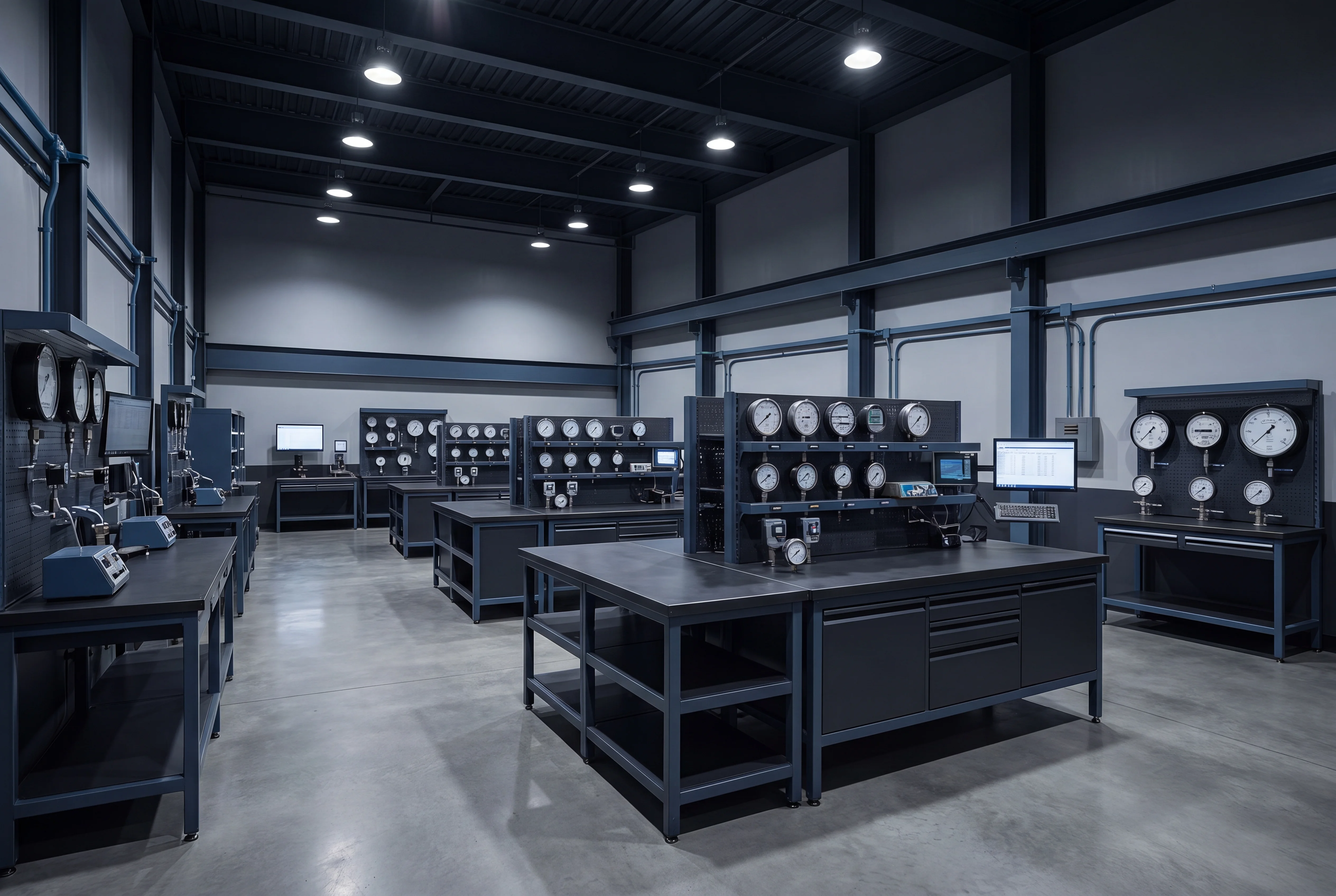
Bourdon Tube Pressure Gauge Calibration
Bourdon tube pressure gauge calibration requires precise control of environmental conditions and metrological traceability to address inherent physical characteristics such as hysteresis, linearity, and repeatability. Standard calibration processes are performed in accordance with ASME B40.100, which establishes accuracy grades, testing procedures, and permissible error limits for dial-indicating pressure gauges. Mechanical elements, including C-type, helical, or spiral Bourdon tubes, are subjected to controlled pressure increments and decrements to characterize elastic deformation behavior across the full scale of the instrument. To maintain compliance with ISO/IEC 17025 metrological requirements, the following parameters are systematically evaluated:
- Hysteresis and Repeatability: Measurement deviations are analyzed by comparing increasing and decreasing pressure cycles to identify material lag or mechanical wear.
- Linearity and Span: Calibration points are distributed across the gauge range to verify proportional pointer deflection and to adjust internal linkages if deviation exceeds specified tolerances.
- Friction and Tap Testing: The movement mechanism is evaluated before and after tapping the case to detect binding, gear wear, or excessive play in the segment and pinion.
- NIST-Traceable Reference Standards: Pressure generation is controlled using high-precision digital pressure controllers or deadweight testers, ensuring an appropriate test uncertainty ratio.
Diaphragm Pressure Gauge Calibration
Diaphragm pressure gauges are critical in low-pressure applications, sanitary processes, and highly corrosive environments where the process media must remain isolated from the measuring element. Calibration of these specialized instruments is performed to verify the structural integrity of the elastic diaphragm and the precision of the mechanical linkage transferring deflection to the pointer assembly. This metrological verification is executed in accordance with standards such as ASME B40.100 and Euramet cg-17, utilizing pneumatic or hydraulic pressure standards with direct NIST traceability.
Because diaphragm elements are susceptible to material fatigue, elastic hysteresis, and temperature-induced zero shifts, precise calibration procedures evaluate performance across multiple upscale and downscale points. The following parameters are systematically assessed during the process:
- Hysteresis and repeatability: Assessing variance in readings when pressure is increased versus decreased to identify potential material fatigue or mechanical binding.
- Linearity and conformity: Verifying that the non-linear displacement of the diaphragm translates uniformly across the graduated scale.
- Zero-point deviation: Quantifying shift anomalies caused by system overpressure or permanent set in the elastic element.
- Environmental thermal stability: Characterizing temperature-induced drift relative to calibrated reference baselines under controlled ambient conditions.
Pressure Gauge Calibration in Green Bay
The Fox River industrial corridor in Green Bay, Wisconsin, maintains a heavy concentration of pulp, paper, and packaging manufacturing facilities. Operations at major regional installations, such as those managed by Green Bay Packaging and Georgia-Pacific, rely heavily on complex steam distribution networks, chemical digesters, and massive hydraulic presses. In these rigorous environments, pressure gauge calibration is required to maintain the safety and efficiency of high-pressure steam lines and pneumatic control loops. Analog Bourdon tube gauges, diaphragm seals, and digital pressure transmitters must be routinely verified against traceable reference standards. This verification prevents boiler over-pressurization, ensures consistent web tension during paper production, and stabilizes the flow of caustic chemicals in the pulping process. The local manufacturing base demands accurate pressure measurement ranging from deep vacuum in suction rolls to over 10,000 psi in heavy industrial hydraulic power units.
More on pressure gauge calibration in Green Bay
Beyond corrugated medium and tissue production, the Green Bay local economy is driven by significant food processing and dairy operations, including extensive facilities operated by Schreiber Foods and JBS. Food-grade pressure gauges utilized in Clean-in-Place (CIP) systems, homogenization processes, and pasteurization networks require precise calibration to meet critical sanitation mandates and exact temperature-pressure correlations. Sanitary pressure instruments must be regularly assessed for zero shift and span errors caused by frequent thermal cycling during intensive washdown procedures. Furthermore, the region's maritime industry and heavy fabrication sectors located near the bay utilize heavy-duty hydraulic lifts, gantry cranes, and fluid power systems that operate under fluctuating load conditions. For these industrial sectors across Brown County, documented verification of pressure measurement devices mitigates the risk of catastrophic system failures, ensures process uniformity, and minimizes unplanned downtime in continuous-process manufacturing operations.
- Pulp and Paper Systems: Calibration of differential pressure transmitters across filters and vacuum gauges on Fourdrinier machines to optimize water removal.
- Sanitary Dairy Processes: Verification of 3-A sanitary standard compliant gauges equipped with tri-clamp fittings to prevent media contamination.
- Heavy Maritime Hydraulics: High-pressure verification for load-bearing hydraulic cylinders and pneumatic actuators used in shipping and logistics handling.
Regulatory Compliance and Calibration Standards
The calibration of pressure gauges within Green Bay's industrial and municipal sectors is governed by stringent metrological standards, primarily ASME B40.100. This standard defines the accuracy classes, dial nomenclature, and rigorous testing protocols for indicating dial-type pressure instruments. Metrology laboratories and on-site calibration procedures must align with ISO/IEC 17025 requirements to establish absolute technical competence and ensure valid, repeatable measurement results. All applied reference standards, whether precision deadweight testers or high-accuracy digital calibrators, are mandated to maintain unbroken chains of traceability to the National Institute of Standards and Technology (NIST). This unbroken traceability is essential for facilities utilizing high-grade test gauges, such as Grade 3A (0.25 percent full scale) or Grade 4A (0.1 percent full scale), which demand calibration uncertainties significantly lower than the instrument under test. Standard metrology practice dictates adherence to a minimum 4:1 Test Uncertainty Ratio (TUR) to properly manage consumer risk and measurement drift over time.
For the local dairy and meat processing facilities in Brown County, pressure calibration intersects directly with state and federal food safety regulations. Process instrumentation must frequently comply with FDA 21 CFR Part 113 for thermally processed low-acid foods, where even minor pressure deviations in retort processing vessels can completely compromise product sterility. Calibration procedures for these critical control points must assess and correct for hysteresis, repeatability, and linearity errors across the entire operating span. Additionally, sanitary pressure gauges equipped with capillary tubes and diaphragm seals must be calibrated to account for fluid fill expansion and temperature-induced density changes.
Industrial boiler operators and power generation facilities along the Fox River are subject to strict jurisdictional safety audits under the National Board Inspection Code (NBIC) and the Wisconsin Department of Safety and Professional Services (DSPS) regulations. These binding codes dictate mandatory recalibration intervals for safety relief valves and their associated pressure monitoring gauges to prevent explosive decompression events. Environmental compliance also hinges on accurate pressure data; facilities must monitor differential pressure across baghouses and wet scrubbers to maintain EPA compliance for continuous emissions monitoring systems (CEMS). Calibration certificates must thoroughly document as-found and as-left data, environmental conditions during the test, and the specific reference standards utilized, providing an auditable trail for regulatory inspectors.
Related Services
Digital Pressure Gauge Calibration
View in Green Bay ↗ RelatedManometer Calibration
View in Green Bay ↗ RelatedPressure Transmitter, Transducer & Sensor Calibration
View in Green Bay ↗ RelatedPressure Switch & Relief Valve Calibration
View in Green Bay ↗ RelatedLeak Tester Calibration
View in Green Bay ↗ RelatedPiston Gauge Calibration
View in Green Bay ↗Request pressure gauge calibration in Green Bay.
Submit instrument details to receive an itemized quote within one business day. NIST-traceable results, documented for audit and compliance.