Accredited Industrial Manometer Calibration in Detroit, MI
Manometer Calibration in Detroit, MI is performed by ISO/IEC 17025-accredited laboratories to recognized acceptance criteria, with documented uncertainty and NIST-traceable results.
Quote Manometer Calibration — Detroit
Response within one business day
Service Overview
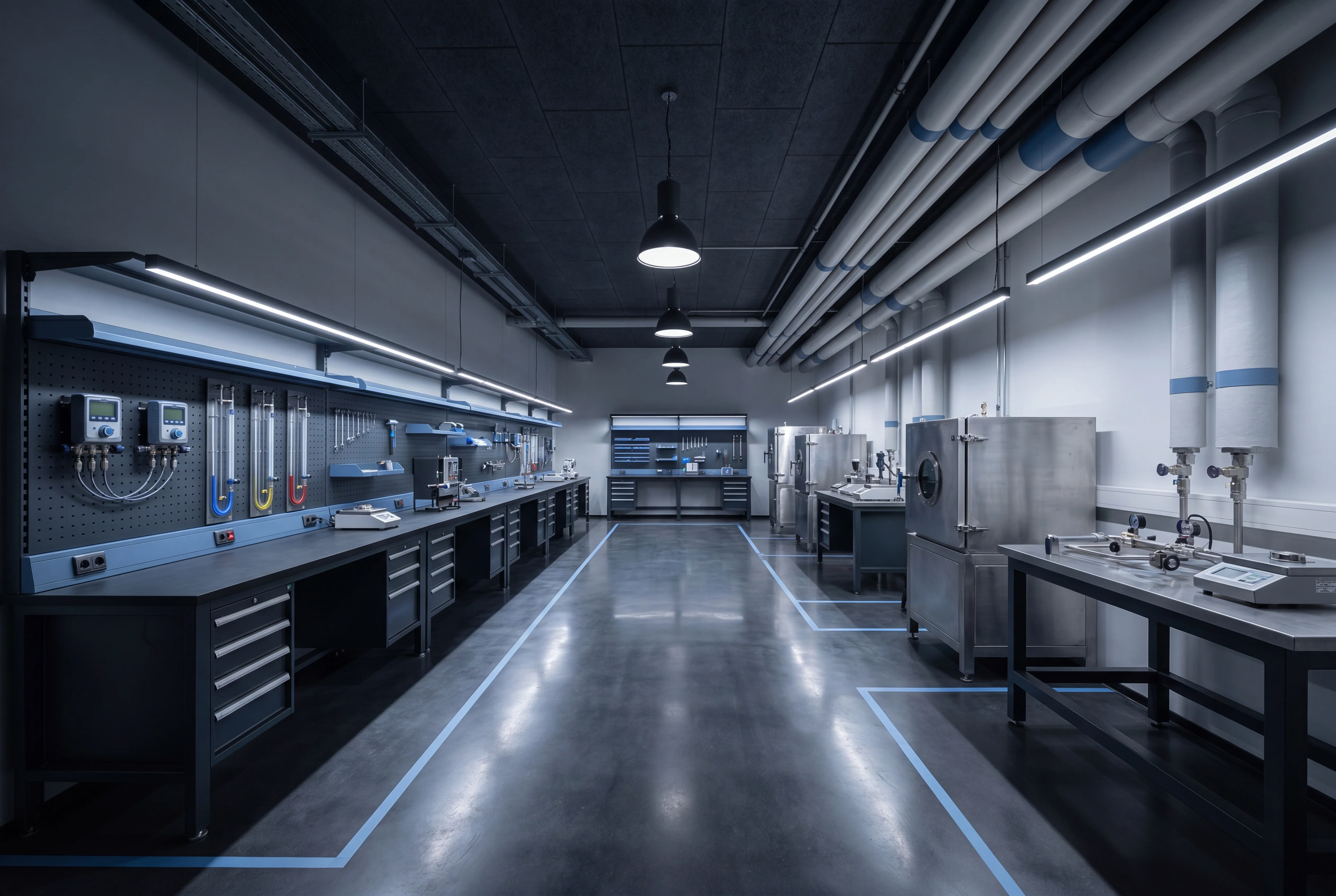
U-tube Manometer Calibration
Calibration of U-tube manometers requires rigorous evaluation of both the primary measurement scale and the fluid dynamics that dictate the indicated pressure. Because these instruments rely on the physical displacement of a liquid column - typically utilizing water, mercury, or proprietary gauge fluids - the calibration process must meticulously account for environmental variables that directly alter fluid density and hydrostatic equilibrium. Calibration is performed under ISO/IEC 17025 accreditation protocols to ensure documented measurement traceability to national metrology standards, such as those maintained by NIST. The verification procedure involves applying highly stable reference pressures using precision automated controllers or deadweight testers, subsequently comparing the standard against the manometer's observed differential height.
Critical parameters evaluated during this calibration sequence include:
- Verification of scale linearity, absolute zero-point alignment, and graduation accuracy across the entire operational range.
- Application of critical temperature corrections, as thermal expansion continuously alters the specific gravity of the indicating fluid.
- Mathematical compensation for local gravity variations, which fundamentally impact the primary hydrostatic pressure calculation.
- Inspection of the bore tubing for internal contamination or surface tension anomalies that could distort the meniscus and induce parallax reading errors.
- Pneumatic leak testing of the manifold and connection fittings to confirm absolute system integrity under sustained static pressure.
Digital Manometer Calibration
Digital manometer calibration is performed under strict ISO/IEC 17025 accredited procedures to ensure the integrity of electronic pressure measurements. Unlike liquid-column counterparts, digital manometers rely on piezoresistive or silicon capacitive sensors, which require precise voltage-to-pressure correlation. High-accuracy pneumatic or hydraulic comparators are utilized alongside NIST-traceable reference standards to evaluate the device across its full operating range. The calibration process involves multi-point verification to analyze key performance characteristics:
- Hysteresis and Linearity: Assessment of sensor response during both increasing and decreasing pressure cycles to identify deviations in the transducer element.
- Repeatability: Evaluation of the instrument's ability to provide consistent readings under identical pressure conditions.
- Zero and Span Adjustment: Corrections applied to align the digital output with reference standards at both zero pressure and full-scale limits.
- Temperature Effects: Verification of thermal compensation stability, as digital sensors are susceptible to drift caused by ambient temperature fluctuations.
All measurements are conducted in accordance with ASME B40.7 standards, providing documented test uncertainty ratios (TUR) to support industrial compliance and quality management systems.
Manometer Calibration in Detroit
Metro Detroit maintains a highly concentrated infrastructure of research, development, and heavy manufacturing that fundamentally relies on precise fluid and gas pressure measurements. Across Wayne, Oakland, and Macomb counties, the industrial landscape is anchored by massive automotive engineering campuses in Dearborn, Warren, and Auburn Hills, alongside dense networks of Tier 1 and Tier 2 supplier facilities. Within these testing and production environments, both liquid-column and digital manometers are deployed extensively for aerodynamic wind tunnel testing, powertrain dynamometer validation, and exhaust backpressure monitoring. Engine test cells require continuous, high-accuracy differential pressure readings to monitor intake manifold vacuum and combustion airflow. This quantitative data is critical for verifying mechanical performance against stringent design metrics before full-scale production begins.
More on manometer calibration in Detroit
As the regional manufacturing base expands its focus to include electric vehicle battery production and advanced mobility solutions, there is an increased reliance on precision manometers to monitor critical environmental controls. Battery cell assembly cleanrooms and large-scale industrial paint shops, particularly those clustered along the I-75 corridor and the Mound Road industrial zone, require strict positive differential pressure to prevent particulate contamination. The continuous validation of these minute pressure gradients relies entirely on routinely calibrated manometers. Facilities operating within areas like the Detroit Region Aerotropolis must ensure that measurement instruments monitoring process gases and HVAC airflow remain within specified tolerance limits. This strict oversight is necessary to satisfy both internal quality control metrics and broader regional environmental regulations mandated by state authorities.
Calibration Standards and Metrological Compliance for Pressure Instrumentation
Within the Michigan heavy manufacturing ecosystem, pressure measurement compliance is heavily dictated by global quality management systems, particularly IATF 16949, which strictly governs the automotive supply chain. This international standard mandates that all inspection, measuring, and test equipment undergo periodic calibration with documented, unbroken traceability to the National Institute of Standards and Technology (NIST). Manometer calibration procedures are executed in accordance with ISO/IEC 17025 accredited methodologies, ensuring that measurement uncertainty is rigorously calculated, controlled, and reported on the final calibration certificate. For traditional U-tube or inclined liquid manometers utilized in legacy testing environments, the calibration process requires careful mathematical compensation for local gravity deviations and ambient temperature variations, both of which alter the density of the indicating fluid and fundamentally impact measurement accuracy.
Digital manometers, which increasingly dominate modern HVAC monitoring and advanced engine test cells, require comprehensive multipoint pressure characterization. This metrological process involves applying known, highly stable reference pressures across the instrument's full operating span to detect non-linearity, sensor drift, or hysteresis within the internal piezoresistive or capacitive sensing elements. Acceptance criteria and tolerance grades for these devices are frequently guided by standards such as ASME B40.100, alongside specific engineering tolerances dictated by the end-user.
Furthermore, routine verification protocols are necessary to ensure that differential pressure measurements recorded during engine emissions testing conform to Environmental Protection Agency (EPA) regulations under 40 CFR Part 1065. This regulatory framework dictates strict tolerance limits for continuous airflow and combustion pressure data collected during standardized test cycles. Maintenance of properly calibrated manometric instruments is a foundational requirement for facilities operating in the Detroit industrial sector. Undetected deviations in low-pressure measurement can invalidate months of critical research data, compromise cleanroom integrity, or lead to severe non-conformances during rigorous supplier quality audits.
Related Services
Pressure Gauge Calibration
View in Detroit ↗ RelatedDigital Pressure Gauge Calibration
View in Detroit ↗ RelatedPressure Transmitter, Transducer & Sensor Calibration
View in Detroit ↗ RelatedPressure Switch & Relief Valve Calibration
View in Detroit ↗ RelatedLeak Tester Calibration
View in Detroit ↗ RelatedPiston Gauge Calibration
View in Detroit ↗Request manometer calibration in Detroit.
Submit instrument details to receive an itemized quote within one business day. NIST-traceable results, documented for audit and compliance.