Accredited Industrial Differential Pressure & Magnehelic Gauge Calibration in Des Moines, IA
Differential Pressure & Magnehelic Gauge Calibration in Des Moines, IA is performed by ISO/IEC 17025-accredited laboratories to recognized acceptance criteria, with documented uncertainty and NIST-traceable results.
Quote Differential Pressure & Magnehelic Gauge Calibration — Des Moines
Response within one business day
Service Overview
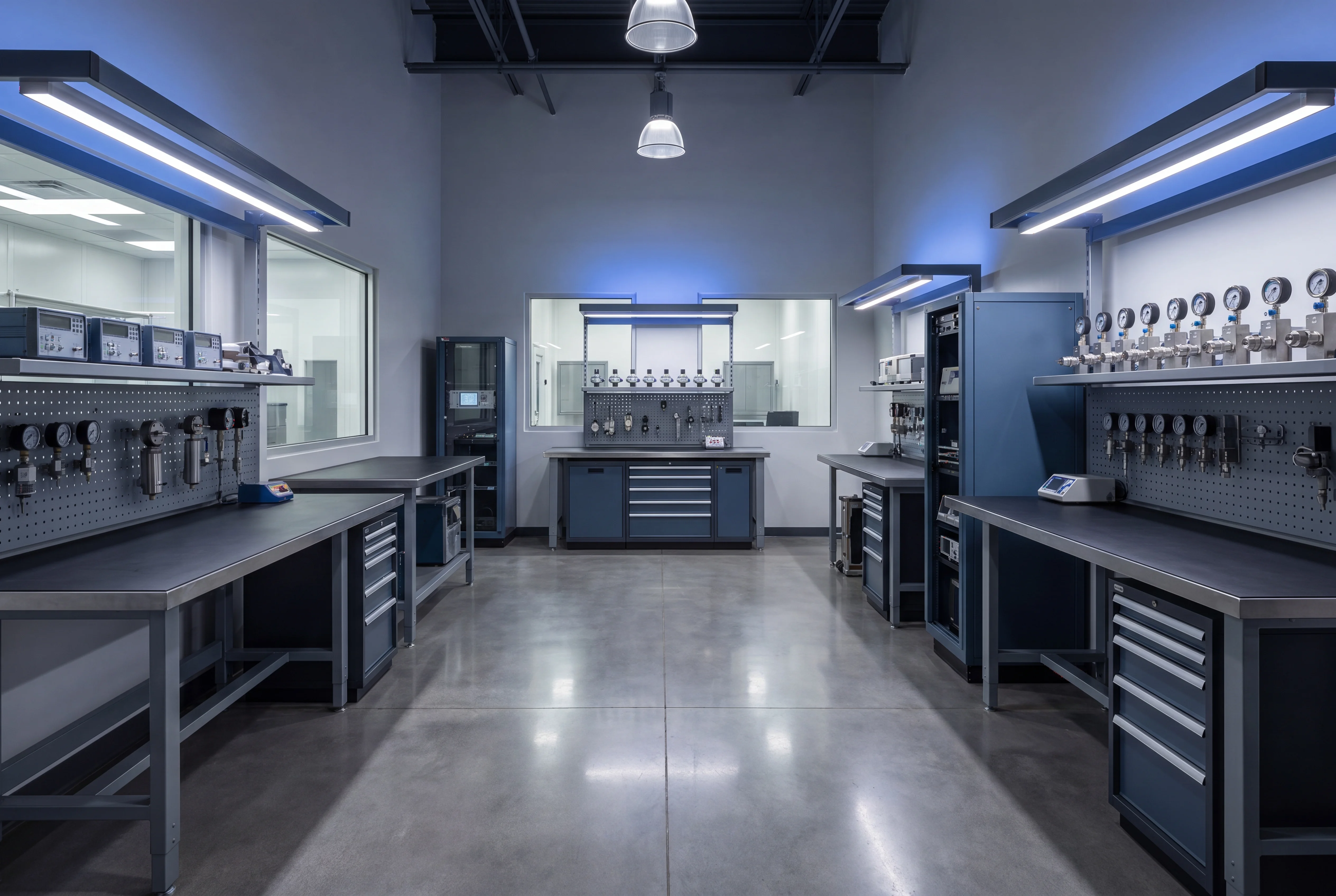
Diaphragm Differential Pressure Gauge Calibration
Diaphragm differential pressure gauges are critical instruments utilized for monitoring low-differential pressure applications, such as cleanroom environments, HVAC systems, and filter status. Because these instruments rely on the deflection of a flexible diaphragm to measure the difference between high and low pressure ports, rigorous calibration is required to detect mechanical wear, hysteresis, and sensor drift. Calibration of diaphragm-actuated instruments is performed using pneumatic deadweight testers or high-precision automated pressure controllers. Throughout the verification process, stable test pressures are applied to generate multi-point assessments across the specified operating range, typically measured in inches of water column (inH2O) or millibar (mbar).
To ensure documented reliability, differential pressure gauge calibration is conducted in accordance with ASME B40.100 guidelines and performed under ISO/IEC 17025 accreditation protocols. Standard verification procedures involve several key metrological assessments:
- Verification of zero-point accuracy and mechanical spanning adjustments.
- Multi-point linearity checks ascending and descending through the pressure scale to evaluate hysteresis.
- Leak testing of the high and low pressure cavities to verify diaphragm integrity.
- Generation of calibration certificates with full metrological traceability to NIST or equivalent national metrology institutes.
Magnehelic Differential Pressure Gauge Calibration
Calibration of Magnehelic differential pressure gauges is executed to ensure accurate measurement of low-pressure air and non-combustible gases across critical HVAC, cleanroom, and industrial environments. Because these instruments rely on sensitive diaphragm and magnetic linkage mechanisms to measure minor pressure differentials - typically ranging from fractions of an inch of water column (inH2O) to several pounds per square inch (psi) - meticulous procedural controls are necessary. The calibration process is performed using high-resolution digital reference manometers or micromanometers to generate precise low-pressure test points. Verification is conducted against documented manufacturer specifications or ASME B40.100 guidelines, typically requiring multi-point checks across the measurement span to evaluate linearity, hysteresis, and indication repeatability.
Measurement data is recorded to verify that instrument performance aligns with stringent operational tolerances. When necessary, internal zero and span adjustments are performed to bring the mechanical indicator back into acceptable operational status. Procedures are executed under controlled environmental conditions to mitigate temperature and ambient pressure variations that can induce significant errors in low-differential readings.
- Verification of diaphragm integrity and frictionless magnetic linkage movement.
- Multi-point pressure generation covering the full analog indicating scale.
- Metrological traceability established through NIST or equivalent National Metrology Institutes.
- Calibration protocols performed in strict accordance with ISO/IEC 17025 accreditation requirements.
Photohelic Differential Pressure Gauge Calibration
Photohelic differential pressure gauges integrate precise visual pressure indication with built-in relay switches for system control, requiring a dual-phase verification approach. Because these instruments serve both as monitors and active control elements in critical air or gas flow systems, calibration is performed to assess mechanical indication accuracy alongside electrical switch functionality. High-accuracy automated pressure controllers or standard reference manometers are utilized to generate stable, low-pressure differentials. These reference pressures are applied across the high and low ports to evaluate the instrument across its full operational range. Validation is performed under strict environmental controls and aligns with ISO/IEC 17025 accreditation parameters, ensuring all measurements maintain documented traceability to NIST.
The calibration protocol for photohelic instruments routinely encompasses the following technical evaluations:
- Verification of visual dial indication across multiple distributed points on the specific pressure scale.
- Actuation testing of high and low limit switches to determine exact set-point accuracy and repeatability.
- Measurement of the mechanical deadband, or hysteresis, during both rising and falling pressure cycles to verify relay stability.
- Zero-point verification, structural leak testing across the internal diaphragm assembly, and necessary mechanical span adjustments.
Technical Detail
Digihelic Differential Pressure Gauge Calibration
Calibration of digital differential pressure controllers, commonly known as digihelic gauges, encompasses both pneumatic pressure verification and electrical signal measurement. Because these instruments function simultaneously as a local indicating display, a 4-20 mA transmitter, and a dual-relay pressure switch, a comprehensive calibration protocol is required to ensure multi-variable accuracy. Low-differential pressure references are utilized to apply stable, controlled test media across the high and low pressure ports, targeting specific measurement ranges that are often scaled in inches of water column (in w.c.) or Pascals.
The calibration procedure for digihelic-style instruments typically includes:
- Verification of the digital display across a multi-point scale to assess linearity, repeatability, and hysteresis against a high-accuracy standard.
- Measurement of the analog 4-20 mA output signal using precision digital multimeters to confirm transmitter output accuracy.
- Testing of the solid-state control switches to ensure activation and deactivation occur strictly within the programmed setpoint tolerances.
- Application of necessary zero and span adjustments to correct output drift resulting from piezoresistive sensor fatigue or minor overpressure events.
All differential pressure measurements and concurrent electrical verifications are performed under strict ISO/IEC 17025 accreditation parameters, ensuring unbroken metrological traceability to the National Institute of Standards and Technology (NIST). Fully documented test data, complete with calculated measurement uncertainties, verifies that the controller meets the stringent tolerance limits required for critical cleanroom environments, HEPA filter monitoring, and complex industrial ventilation systems.
Differential Pressure & Magnehelic Gauge Calibration in Des Moines
The Des Moines metropolitan area, encompassing key industrial zones such as the Crossroads Business Park and the Northeast 14th Street corridor, presents a robust landscape for differential pressure instrumentation. A primary driver for Magnehelic gauge and DP transmitter calibration in this region stems from the heavy concentration of agricultural processing, bioscience facilities, and advanced manufacturing. Agribusiness campuses and extensive grain handling operations rely heavily on differential pressure monitoring for pneumatic conveying systems, grain drying environments, and massive dust collection baghouses. In these agricultural and industrial applications, Magnehelic gauges are installed across filter media to measure pressure drops that indicate filter blinding, airflow restriction, or catastrophic media rupture. Routine calibration of these instruments is not merely an operational formality; it is deeply tied to environmental compliance, ensuring airborne particulate containment mechanisms operate within the strict emission thresholds established by the Iowa Department of Natural Resources (DNR) and federal occupational safety mandates.
More on differential pressure & magnehelic gauge calibration in Des Moines
Beyond traditional agribusiness, the rapid proliferation of hyperscale data centers in suburbs like Altoona and West Des Moines has fundamentally shifted regional demand for precise, low-range pressure calibration. Massive server farms necessitate highly complex, high-efficiency HVAC infrastructure to maintain strict temperature and humidity profiles across thousands of square feet of equipment space. Within these industrial air handler units, differential pressure sensors are tasked with controlling variable frequency drive fan speeds, monitoring chilled water loop performance, and verifying the integrity of critical air filtration systems. Building automation systems depend on absolute metrological accuracy from these DP transmitters to optimize power usage effectiveness and prevent thermal events. Furthermore, precision manufacturing hubs throughout the Des Moines and Ankeny corridors utilize differential pressure monitoring for isolating cleanroom environments, maintaining negative pressure in paint booth ventilation systems, and monitoring process gas filtration. The diverse climatic conditions of central Iowa, featuring extreme seasonal temperature and humidity fluctuations, place additional dynamic stress on HVAC and building envelope pressure management, necessitating frequent verification of all associated pressure instrumentation.
Regulatory Frameworks and Metrological Standards for DP Gauge Verification
Verification and adjustment of Magnehelic gauges and electronic differential pressure transmitters must adhere to strict metrological standards to ensure operational validity, process safety, and regulatory compliance. The foundational framework governing these calibration activities is ISO/IEC 17025, which dictates the rigorous competency requirements for testing and calibration protocols. All low-pressure calibration processes must demonstrate an unbroken, documented chain of traceability to the National Institute of Standards and Technology (NIST) or equivalent national metrology institutes. For standard industrial DP gauges utilized in general HVAC or filtration, procedures typically align with ASME B40.100 guidelines. However, specialized pharmaceutical manufacturing environments or biological research facilities operating within the Des Moines area often function under stringent FDA 21 CFR Part 211 mandates regarding critical equipment calibration and maintenance. These highly regulated environments require comprehensive, audit-ready documentation, including rigorously calculated measurement uncertainties, recorded environmental conditions at the time of testing, and detailed as-found and as-left performance data.
The technical execution of differential pressure calibration involves highly stable, low-pressure generation and reference standards capable of micro-inch water column (inH2O) or fractional Pascal resolution. Mechanical measurement devices, such as diaphragm-actuated Magnehelic gauges, are inherently susceptible to specific metrological drifts over time and heavy use, including mechanical hysteresis, zero-shift, and span degradation. Calibration procedures dictate that these units must be tested in their exact orientation of use - typically vertical - as changes in physical mounting orientation directly alter the gravitational tension on internal leaf springs and magnet alignments, thereby shifting the baseline zero point. Acceptance criteria are strictly defined by the manufacturer's specified tolerance grades, which generally span from 2 percent to 4 percent of full scale for standard analog models, while critical digital transmitters may demand much tighter tolerances. During the verification cycle, precise test pressures are applied in both ascending and descending increments across the entire operational scale. This bidirectional testing methodology is absolutely critical for quantifying hysteresis and ensuring a linear, repeatable response profile. For local facilities managing critical cleanroom environments classified under ISO 14644 standards, any gauge deviation beyond the specified tolerance limits mandates immediate mechanical adjustment or replacement to prevent systemic contamination events caused by the loss of positive pressure isolation.
Related Services
Pressure Gauge Calibration
View in Des Moines ↗ RelatedDigital Pressure Gauge Calibration
View in Des Moines ↗ RelatedManometer Calibration
View in Des Moines ↗ RelatedPressure Transmitter, Transducer & Sensor Calibration
View in Des Moines ↗ RelatedPressure Switch & Relief Valve Calibration
View in Des Moines ↗ RelatedLeak Tester Calibration
View in Des Moines ↗Request differential pressure & magnehelic gauge calibration in Des Moines.
Submit instrument details to receive an itemized quote within one business day. NIST-traceable results, documented for audit and compliance.