Accredited Industrial Manometer Calibration in Bloomington, MN
Manometer Calibration in Bloomington, MN is performed by ISO/IEC 17025-accredited laboratories to recognized acceptance criteria, with documented uncertainty and NIST-traceable results.
Quote Manometer Calibration — Bloomington
Response within one business day
Service Overview
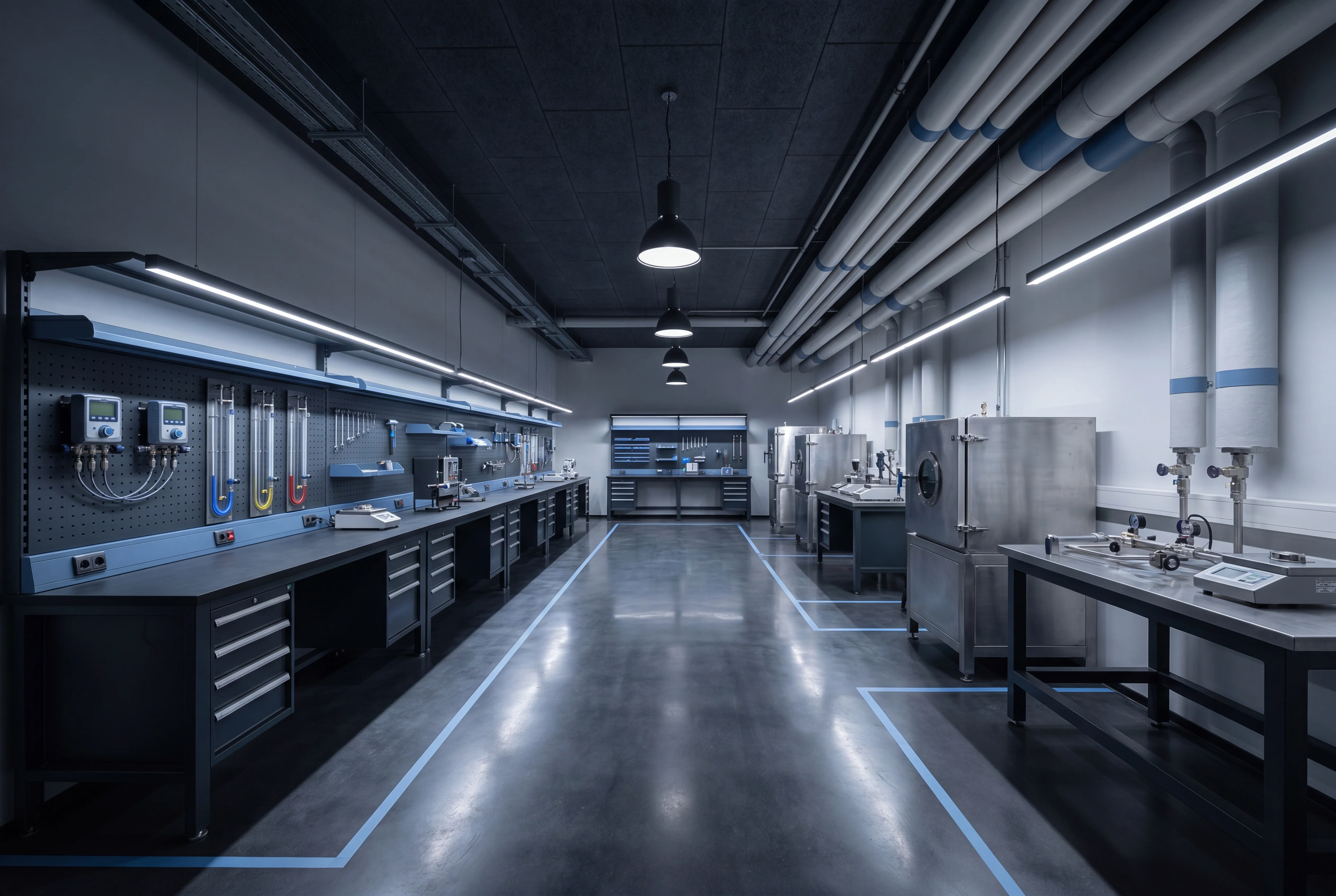
U-tube Manometer Calibration
Calibration of U-tube manometers requires rigorous evaluation of both the primary measurement scale and the fluid dynamics that dictate the indicated pressure. Because these instruments rely on the physical displacement of a liquid column - typically utilizing water, mercury, or proprietary gauge fluids - the calibration process must meticulously account for environmental variables that directly alter fluid density and hydrostatic equilibrium. Calibration is performed under ISO/IEC 17025 accreditation protocols to ensure documented measurement traceability to national metrology standards, such as those maintained by NIST. The verification procedure involves applying highly stable reference pressures using precision automated controllers or deadweight testers, subsequently comparing the standard against the manometer's observed differential height.
Critical parameters evaluated during this calibration sequence include:
- Verification of scale linearity, absolute zero-point alignment, and graduation accuracy across the entire operational range.
- Application of critical temperature corrections, as thermal expansion continuously alters the specific gravity of the indicating fluid.
- Mathematical compensation for local gravity variations, which fundamentally impact the primary hydrostatic pressure calculation.
- Inspection of the bore tubing for internal contamination or surface tension anomalies that could distort the meniscus and induce parallax reading errors.
- Pneumatic leak testing of the manifold and connection fittings to confirm absolute system integrity under sustained static pressure.
Digital Manometer Calibration
Digital manometer calibration is performed under strict ISO/IEC 17025 accredited procedures to ensure the integrity of electronic pressure measurements. Unlike liquid-column counterparts, digital manometers rely on piezoresistive or silicon capacitive sensors, which require precise voltage-to-pressure correlation. High-accuracy pneumatic or hydraulic comparators are utilized alongside NIST-traceable reference standards to evaluate the device across its full operating range. The calibration process involves multi-point verification to analyze key performance characteristics:
- Hysteresis and Linearity: Assessment of sensor response during both increasing and decreasing pressure cycles to identify deviations in the transducer element.
- Repeatability: Evaluation of the instrument's ability to provide consistent readings under identical pressure conditions.
- Zero and Span Adjustment: Corrections applied to align the digital output with reference standards at both zero pressure and full-scale limits.
- Temperature Effects: Verification of thermal compensation stability, as digital sensors are susceptible to drift caused by ambient temperature fluctuations.
All measurements are conducted in accordance with ASME B40.7 standards, providing documented test uncertainty ratios (TUR) to support industrial compliance and quality management systems.
Manometer Calibration in Bloomington
The industrial ecosystem in Bloomington, Minnesota, particularly within the high-density technology corridors situated along Interstate 494 and Interstate 35W, generates substantial requirements for precise pressure measurement instrumentation. Within Hennepin County, the local manufacturing landscape is heavily anchored by advanced technology sectors, including semiconductor fabrication facilities, aerospace component testing, and major medical device production centers. These specific industries operate expansive cleanroom environments, research and development laboratories, and controlled production floors where atmospheric pressure management is critical. Manometers, encompassing both high-resolution digital models and traditional liquid-column instruments, are extensively deployed throughout these Bloomington facilities to monitor differential pressure across cascading cleanroom zones, biosafety cabinets, and laminar flow hoods.
More on manometer calibration in Bloomington
In the West Bloomington industrial sectors and the South Loop district, medical technology producers utilize these instruments to ensure that positive pressure is consistently maintained in sterile assembly areas, inherently preventing the ingress of airborne particulates. The operational pressures on facility engineers and quality assurance personnel in this geographic region are acute due to the sensitive nature of the manufactured goods. Microelectronics operations require localized exhaust ventilation and precise make-up air balancing, processes that are heavily dependent on accurate inclined and digital manometers. Drift or degradation in manometer accuracy can severely compromise the pressure differentials required to maintain product yield rates and environmental sterility. Consequently, rigorous manometer calibration is integrated directly into the preventive maintenance schedules of local manufacturing plants to mitigate the risks associated with HVAC system fluctuations, HEPA filter loading, and environmental cross-contamination.
Regulatory Frameworks and Traceability Requirements
Metrological control of manometers in these highly regulated environments is governed by stringent international standards and federal regulations. For the concentration of medical device manufacturers operating in Bloomington, compliance with FDA 21 CFR Part 820 (Quality System Regulation) dictates that all inspection, measuring, and test equipment, explicitly including low-pressure monitoring manometers, must be routinely calibrated according to documented and validated procedures. The calibration of these measurement devices requires an unbroken, documented chain of traceability to the National Institute of Standards and Technology (NIST). Furthermore, calibration laboratories supporting these manufacturing facilities typically operate in strict accordance with ISO/IEC 17025, ensuring that measurement uncertainty is mathematically quantified, rigorously verified, and reported for each tested point along the instrument's operational range.
The technical acceptance criteria for manometers utilized in cleanroom monitoring depend heavily on the required tolerance grades defined by the facility's specific compliance frameworks. For critical differential pressure applications regulated by ISO 14644 standards for cleanrooms and associated controlled environments, manometers often operate in micro-pressure ranges, frequently measuring between 0 and 0.25 inches of water column (inH2O). Calibration methodologies for these sensitive low-range digital and micromanometers involve pneumatic comparisons against highly accurate primary or secondary standards, such as precision pressure controllers or deadweight testers. The calibration process meticulously evaluates critical performance characteristics, including zero-point stability, linearity, and repeatability.
Standardized procedures for manometer assessment are further informed by engineering documents such as ASME B40.100, which outlines the terminology, specifications, and testing methods for pressure indicating instruments. When calibrating digital manometers equipped with piezoresistive or capacitance sensors, protocols must account for environmental variables within the metrology laboratory, including ambient temperature and barometric pressure variations, which can significantly influence micro-pressure readings. The testing sequence generally encompasses multiple verification points across the full scale of the instrument, incorporating both ascending and descending pressure cycles to accurately calculate mechanical or electronic hysteresis. Comprehensive documentation must detail "as found" and "as left" data, ensuring that any deviation from the specified tolerance is evaluated for its impact on previously manufactured batches, thereby satisfying the rigorous compliance audits characteristic of the Minnesota medical and microelectronics manufacturing sectors.
Related Services
Pressure Gauge Calibration
View in Bloomington ↗ RelatedDigital Pressure Gauge Calibration
View in Bloomington ↗ RelatedPressure Transmitter, Transducer & Sensor Calibration
View in Bloomington ↗ RelatedPressure Switch & Relief Valve Calibration
View in Bloomington ↗ RelatedLeak Tester Calibration
View in Bloomington ↗ RelatedPiston Gauge Calibration
View in Bloomington ↗Request manometer calibration in Bloomington.
Submit instrument details to receive an itemized quote within one business day. NIST-traceable results, documented for audit and compliance.